Showing posts with label blake snyder. Show all posts

Monday, July 16, 2018

5 Quotes About Writing

A quick inspirational quote always adds fuel to my tank. Here are five of my favorites:


As usual, you're welcome to share these pictures, but be sure to give proper credit to David Purse for the photos and link back to this post.


Do you have a favorite writing quote that motivates you? Please share in the comments.


Tuesday, September 20, 2016

More Inspirational Writing Quotes

Looking for a boost or a kick in the right direction? Here are three tips from the writing experts:


Now get off the Internet and get back to your writing project!


Tuesday, September 6, 2016

Inspirational Writing Quotes

From @savethecat - "The plot doesn't just move ahead, it spins and intensifies as it goes." 


What's your favorite writing quote?

Wednesday, March 2, 2016

#IWSG: Inspiring Quotes for Your Daily #Writing

http://www.insecurewriterssupportgroup.com/

Here are FIVE quotes to help get your fingers tapping on the keyboard today!


"Look for nodes of conjunction, such as setting. For instance, suppose in your main story line you have a wedding, while a subplot involves a breakup. Why not have both occur at the same time and in the same place?" -- Donald Maass (WRITING THE BREAKOUT NOVEL, p.188)

"Setting is a powerful storytelling element, and it certainly makes its mark on dialogue. Where you set a scene shapes what the characters in the scene say and how they say it." -- Deborah Halverson (WRITING YA FICTION FOR DUMMIES, p.80)

"Show, Don't Tell ... You want to make sure the audience knows about a guy's N.Y. Giants past? Show team pictures on the wall of his apartment." -- Blake Snyder (SAVE THE CAT, p. 147)

"Capture how a place makes a point-of-view character feel." -- Donald Maass (WRITING THE BREAKOUT NOVEL, p.101)

"Think of each scene as a mini-movie. It must have a beginning, middle, and an end. And it must also have something happen that causes the emotional tone to change drastically." -- Blake Snyder (SAVE THE CAT, p. 110)

Tuesday, November 24, 2015

5 Inspiring Quotes for #Writing

Need a little push to get your writing off the ground today?


Here are five of my favorite quotes on the topic:


"Wounded villains often wear their wounds like a badge and use them to justify their villainy." -- James Frey (HOW TO WRITE A DAMN GOOD THRILLER)

"Whether or hero is skilled or not, it's the relative size of the challenge that makes these stories work. And one rule of thumb is: The badder the bad guy, the greater the heroics." -- Blake Snyder (SAVE THE CAT)

"If your every sentence admits a doubt, your writing will lack authority. Save the auxiliaries would, should, could, may, might, and can for situation involving real uncertainty." -- Strunk & White (THE ELEMENTS OF STYLE)

"Whatever drives the main character ... make sure it is an inner conflict as powerful as any outer conflict could hope to be: urgent, unavoidable, and full of an emotional appeal that anyone can feel." -- Donald Maass (WRITING THE BREAKOUT NOVEL)

"YA writers must master ... a youthful sensibility. Young people are learning to be self-aware rather than self-centric, and their appreciation of others' places ... in the world is still maturing. ... see the world as youngsters see it, letting that view influence your phrasing and sentiments." -- Deborah Halverson (WRITING YA FICTION FOR DUMMIES)


How about you? Do you have a favorite writing quote? Share it in the comments. :) Happy writing!

Tuesday, April 22, 2014

S is for SAVE THE CAT


So … you want to be a writer? Where do you start? How do you get there? No worries. This month I’ll be sharing my A to Z list of writer’s resources: books, blogs, and beyond! Check back each day to find helpful resources for improving your writing and navigating your way through the publishing industry.


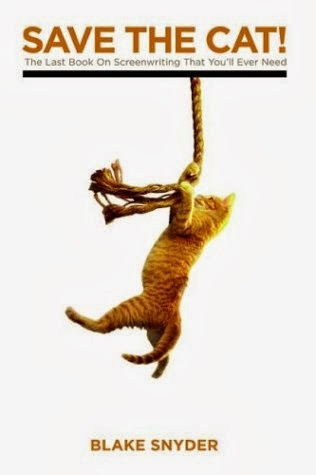
S is for SAVE THE CAT by Blake Snyder

Seriously, if you haven't read this book yet ... WHAT are you waiting for?


Have you already read SAVE THE CAT? If so, did you find it helpful?

Friday, October 11, 2013

A Killer Title

I have read (and own) quite a few books on the craft of writing, but very few tackle the topic of creating a great title.

SAVE THE CAT by Blake Snyder dedicates a page and a half to the topic, which is more than the other books. ;)


Snyder writes, "to come up with one that nails the concept, without being so on the nose that it's stupid, is an art unto itself" (page 9).

Right ... we know that ... but how do we come up with that great title that nails the concept?

I dunno.

Evidence: My debut novel was originally titled THE EDUCATION OF THIA. After several agents used the phrase "too didactic" in their rejection letters, I reconsidered the title and changed it to BUT HE LOVES ME. With that change alone (I left the content of the query letter the same) I received quite a few requests for the full manuscript. So was it a winning title? Not really. After signing with an awesome agent, we worked and worked and worked to come up with a better title. We decided on SAFE. A winner? Not sure. The editor who made an offer on the manuscript said we had to change the title. Okay. Back to the drawing board.

Snyder also writes, "Title and logline are, in fact, the one-two punch, and a good combo never fails to knock me out. Like the irony in a good logline, a great title must have irony and tell the tale. One of the best titles of recent memory, and one I still marvel at, is Legally Blonde. ... It says what it is! ... If it doesn't pass the Say What It Is Test, you don't have your title. And you don't have the one-two punch" (pages 9-10).

So here is the logline my agent used to sell my manuscript:
Margo Kelly’s debut SAFE is a modern take on “the call is coming from inside the house” old urban legend, in which a young girl falls in love with a guy online who comes for her.

And here's the new title my editor and I came up with:
WHO RU REALLY?

Does it pass the Say What It Is Test? Or is it so "on the nose that its stupid?"

Actually, don't answer the second question.

Naming a book is like naming a child. Inevitably someone is going to hate the name, and you can't possibly please everyone.

*sigh*

BUT the good news is, I have a KILLER TITLE for my next book. ;)

Monday, May 13, 2013

Stop Asking So Many Questions!

Blake Snyder writes, "The hero knows and others around him look to him for answers, not the other way around. if you see a lot of question marks in your hero's dialogue, there's a problem" (SAVE THE CAT, p. 146).

So ... "a lot of question marks" ... how many does that equal exactly?

I took the challenge. I use the find feature in Word and discovered my WIP had 900 (exactly) question marks. Now, granted, not all of those were used by my main character, but I took it further and went through the entire ms with a fine tooth comb.

Of those 900 question marks, 511 belonged to my MC. Yikes. That's probably what Snyder meant by "a lot."

HOWEVER, to my defense, not all of those question marks were in dialogue. A LOT were in her inner monologue. Is that better or worse?

Well, again, upon further examination, I discovered that most of those questions she asked silently to herself were completely unnecessary. I could delete them without changing the meaning of the paragraph, scene, chapter, or plot. *sigh*

I also discovered that many of the questions in her dialogue could be altered to be said as a statement rather than a question, which resulted in a much stronger voice coming from my MC.

After cleaning up the ms, I had eliminated 123 questions - all from my MC. Is that enough? I don't know, yet.

I'll make another pass through the ms and have another beta reader take a look.

What do you think? Does your MC ask a lot of questions? Do you think that's a bad thing?

Friday, October 19, 2012

All is Lost


"The All is Lost Point ... is the place where mentors go to die, presumably so their students can discover "They had it in them all along." The mentor's death clears the way to prove that" - - Blake Snyder (SAVE THE CAT, p.86).

Wednesday, August 22, 2012

The Finale

From Blake Snyder's book, SAVE THE CAT, here's what he advises for the finale:

"This is where we wrap it up. It's where the lessons learned are applied. It's where the character tics are mastered. It's where A story and B story end in triumph for our hero. It's the turning over of the old world and a creation of a new world order -- all thanks to the hero, who leads the way based on what he experienced in the upside-down, antithetical world of Act Two."

"The finale entails the dispatching of all the bad guys, in ascending order. Lieutenants and henchman die first, then the boss. The chief source of the "the problem" -- a person or thing -- must be dispatched completely for the new world order to exist. ... the finale is where a new society is born. It's not enough for the hero to triumph, he must change the world. The finale is where it happens. and it must be done in an emotionally satisfying way" (page 90).


For more information about Blake Snyder's method:
http://www.blakesnyder.com/

Friday, June 29, 2012

The Blake Snyder Beat Sheet

I haven't been able to write the last two days, because the obligations of life got in the way. (blech) So when I sat down to write this morning, I struggled to begin, but after reading over my "Beat Sheet" I felt reinspired to get my story down on paper.


Here's the short version of Blake Snyder's Beat Sheet, but you really need to read his book to understand it fully:

1. Opening Image
2. Theme Stated
3. Set-Up
4. Catalyst
5. Debate
6. Break into Two
7. B Story
8. Fun and Games
9. Midpoint
10. Bad Guys Close In
11. All is Lost
12. Dark Night of the Soul
13. Break into Three
14. Finale
15. Final Image

Having the basic bones of the story roughed out, helped me remember and refocus where I want my new story to go.

I'm off to write now. I hope you have a GREAT weekend.

Wednesday, June 6, 2012

IWSG: RIGHT Writing Process?!

Today is the day! If you haven't joined the group, check it out at: insecure-writers-support-group


Okay ... still thinking about Stephen King's book ON WRITING. And still getting back into the groove of writing a first draft. I've been revising two other manuscripts for SO LONG, I felt like I'd forgotten how to write a first draft!

I had this BIG plan of plotting out my story, because that's what great books on the craft of writing suggest as the RIGHT process for writing. But it seemed so overwhelming ... I had trouble starting.

Then I read King's book, and he suggests, "... put a group of characters (perhaps a pair; perhaps even just one) in some sort of predicament and then watch them try to work themselves free" (page 161).

That one line gave me the freedom to sit down and just start writing. YAY! But then I hit a road block ... I had questions about the characters ... questions about the path they were taking ... questions about who was the REAL bad guy going to be ... questions about motivations and solutions ... ACK!

So I grabbed Blake Snyder's SAVE THE CAT! book and roughed out a sketch of my story using his "Beat Sheet."

Fresh breath! Now I have a rough idea of how the who are going to do the what and the why and when in my story. It's not plotted out precisely, but I now I know which general route I'm taking to reach my destination. A little bit of Snyder's process plus a little bit of King's process plus a WHOLE lotta my process = pure writing bliss.

And I think the most important writing tip from King's book is:

"The scariest moment is always just before you start. After that, things can only get better" (page 274).

Friday, May 11, 2012

Quote for Inspiration

"... create heroes who: Offer the most conflict in that situation, have the longest way to go emotionally, and are the most demographically pleasing." -- Blake Snyder (SAVE THE CAT)


What do you think about that?

Thursday, April 19, 2012

Quotes


"It is not enough for the hero to triumph, he must change the world." -- Blake Snyder, SAVE THE CAT

"Cracking the door open for teenage drama doesn't mean throwing that door wide for sterotypical characters or hokey dialogue that over-emotes to make up for a flat plot." -- Deborah Halverson, WRITING YOUNG ADULT FICTION FOR DUMMIES

Do you have a writing quote to share?


Friday, April 13, 2012

Logline


Do you write a "logline" before or after you've written your manuscript? Hmm.

According to Blake Snyder, "A logline is the one--or two-- sentence description of your movie that tells us what it is. It must contain a type of hero (that means a type of person plus an adjective that describes him), the antagonist (ditto), and the hero's primal goal. It must have irony, and it must bloom in our brains with potential" (SAVE THE CAT, p.188).

A logline is also known as an elevator-pitch or a hook.

And it is essential because it's the quick one-two punch that excites people about reading your story. And if you can't pack your story into a tasty-bite-sized-morsel, that could mean there are inherent problems with your story.

Now, granted, I wrote my first manuscript with no logline. I just wrote. I didn't know much about the craft or the industry ... I just wrote. And then when I *thought* I was finished with the ms, I started researching how to get an agent and how to write a great query letter. Oops. That became a huge problem for me, because my story was "too big" to be bottled up so tightly. That wasn't MY fault. ... right? ... I figured the problem was with the system.

But then before proceeding with my second ms, I decided to write the query letter FIRST, just as an exercise ... to see if it was helpful or even possible. Hmm.

That's when I realized how important a BASIC storyline is to the success of the process.

Let's look at one of Snyder's loglines:
"A hen-pecked husband finally gets the house to himself one weekend and loses it in a poker game to an unscrupulous gambler" (SAVE THE CAT, p. 49).

HERO: Hen-pecked husband
ANTAGONIST: Unscrupulous gambler
PRIMAL GOAL: Get the house back which will protect his physical survival needs of warmth, sleep, and sex
IRONY: Finally gets the house and loses it
BLOOMS WITH POTENTIAL: Absolutely

I challenge you to write a logline right now - off the top of your head - simply use the formula:

A (adjective) (noun) finally gets the (noun) (phrase) and (verb) (phrase) to (adjective) (noun).

And remember to hint at the primal goal and include irony.

Tuesday, February 7, 2012

Quick Quote for Inspiration

"If your story is worth telling, it must be vitally important to everyone involved."

-- Blake Snyder (Save the Cat, p. 135)

Wednesday, January 25, 2012

The Beginning and The End


Source: http://www.forging-ahead.co.uk/bookends.htm

Have you ever evaluated how the beginning and ending of your manuscript are related? What about the beginning and ending of each chapter? Each scene?

Other than the obvious facts that these are related by plot and characters, consider the following comments from successful people in the industry:

"The opening image is also an opportunity to give us the starting point of the hero. It gives us a moment to see a "before" snapshot ... there will also be an "after" snapshot to show how things have changed. ... The opening and final images should be opposites ... showing a change so dramatic it documents the emotional upheaval ..." (Blake Snyder, SAVE THE CAT, pp. 72-73).

And, Donald Maass spends pages discussing the topic as well. "Does it matter what is the last line of your scene, or the first? Apparently, many authors do not think it does. ... That's a shame. Like a handshake, an opening and closing line can create impressions and expectations. They can set a tone. They can signal where we're going, or what we've done, or serve any number of other useful story purposes. ... Creating them deliberately, is a discipline worth developing. ... Suppose you did a first line / last line draft, doing nothing but honing the bookends of every scene in your manuscript. Would those little changes give your story a bigger and more effective shape?" (Donald Maass, THE FIRE IN FICTION, pp. 69-73).

What do you think?


Source: http://www.forging-ahead.co.uk/bookends.htm

Should every scene, chapter, and story have their "bookends" related in some fashion?